It’s one of the great paradoxes of modern musical theater. The music is iconic, born from the minds behind ABBA. The premise is electric, a Cold War showdown over a chessboard. Yet for decades, the musical “Chess” has been a beautiful, frustrating failure—a show with a legendary score that can’t seem to win the game on stage. Its latest Broadway revival, with a rewritten story by Danny Strong, was meant to finally solve the puzzle. It didn’t.
The show’s reputation precedes it. Since its 1988 Broadway premiere, “Chess” has been known for its stunning music by Tim Rice, Benny Andersson, and Bjorn Ulvaeus, tragically shackled to a problematic book by Rice. The original story of an American and a Russian chess champion battling for supremacy and for the love of one woman got lost in its own complexity. The show closed in just a few months. Strong’s new version for the revival at the Imperial Theatre attempts to fix the narrative, but instead, it may have made the story even more confusing and emotionally hollow.
A Love Story Without a Heart
Musicals live and die by their central romance. The most significant failing of this retooled “Chess” is the love triangle at its core. We have the American chess champion Freddie Trumper (Aaron Tveit), his Hungarian-American girlfriend and professional second, Florence Vassy (Lea Michele), and the Soviet champion Anatoly Sergievsky (Nicholas Christopher). The story hinges on Florence leaving the volatile Freddie for the stoic Anatoly. The problem is, the new script gives the audience no reason to root for this switch.
In this version, Freddie isn’t just a pampered rock-star brat throwing tantrums about yogurt, as he was in a previous iteration. Danny Strong’s book reimagines him as a man struggling with bipolar disorder who is off his medication. Aaron Tveit delivers a career-best performance, portraying Freddie not as a villain but as a deeply disturbed individual in desperate need of help. He becomes the only truly sympathetic character on the stage. This creates a massive narrative problem. When Florence leaves him, it doesn’t feel like an escape from a toxic relationship. It feels like an act of abandonment.
Unsympathetic Characters and Muddled Motives
Lea Michele’s Florence offers little vulnerability to balance the story. Her character is portrayed with a wall of defiance and resentment from the very beginning, but the script never explains the source of her anger. The performance suggests a modern interpretation where female characters must project strength at all times, even at the expense of a believable love story. It feels less like she’s drawn to Anatoly and more like she just wants the spotlight for herself. To make matters worse, Anatoly is a married man with children back in the Soviet Union. He claims it was a politically arranged marriage, but his wife (played by Hannah Cruz) tells a different story. The script leaves it unclear who to believe, making Anatoly’s actions seem callous and Florence’s choice even more questionable.
The result is a central plot where the audience struggles to care who Florence ends up with. The emotional stakes disappear long before the end of the first act. The strong vocal performances from the three leads can’t fix this fundamental flaw. While Tveit, Michele, and Christopher are powerhouse singers, their talent is wasted on characters whose motivations are either confusing or unlikable.
For the record, Judy Kuhn in the original Broadway production made this character very appealing and vulnerable, a quality that today’s musical theater forbids its women to be.
A Metaphor That Falls Flat
Beyond the broken romance, the show’s central theme feels clumsy and outdated. The idea that the game of chess serves as a metaphor for the Cold War between the U.S. and the U.S.S.R. has lost its resonance. This new production seems to know it, too. The show’s narrator, the Arbiter, frequently pokes fun at the very concept he is supposed to be representing. This self-aware humor, including a bizarre and inexplicable reference to Robert F. Kennedy Jr.’s brain, only serves to undermine the drama. It tells the audience not to take any of it seriously.
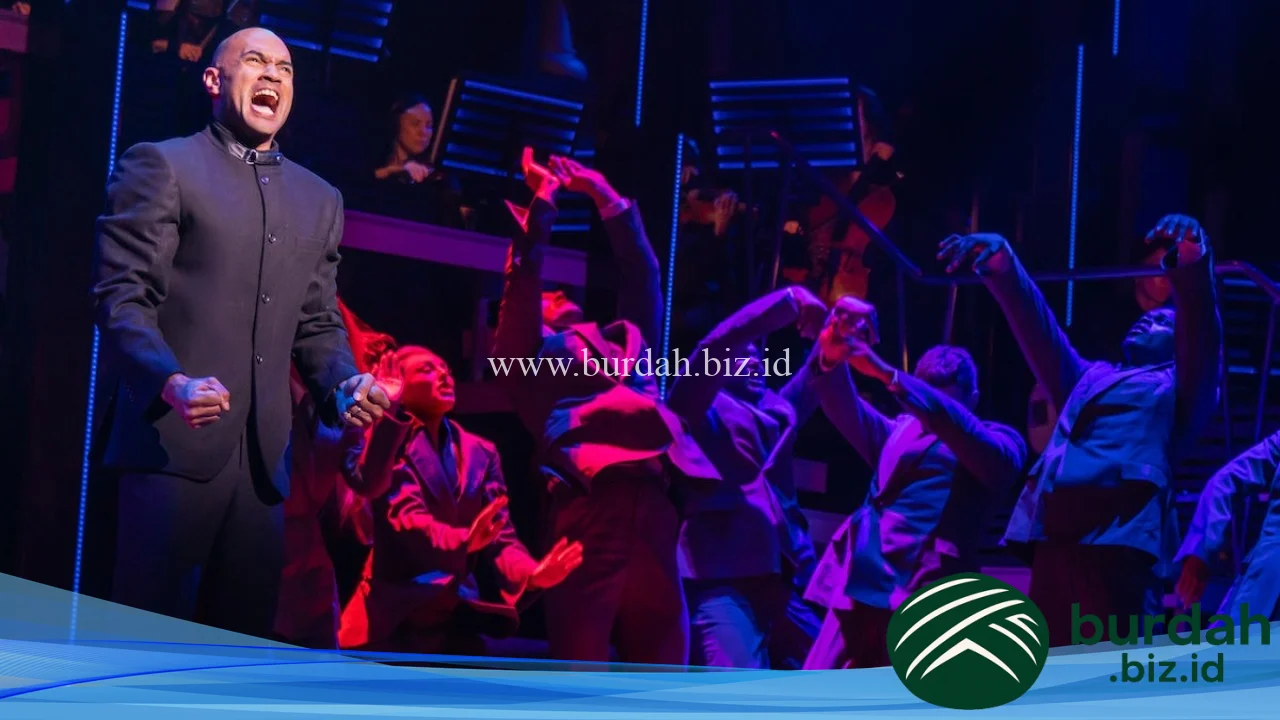
The production itself, directed by Michael Mayer, is staged like a concert with the orchestra visible on a sleek set. It’s a visually impressive choice that highlights the score but also distances the audience from the story. A high point of spectacle, the Act Two opener “One Night in Bangkok,” is presented as a tacky, fun dance number where performers strip down to their underwear. While entertaining, it feels disconnected from the rest of the show, another sign of a production that has style and sound but lacks a coherent soul. Ultimately, “Chess” remains a checkmated musical, full of brilliant pieces that simply cannot be arranged into a winning strategy.