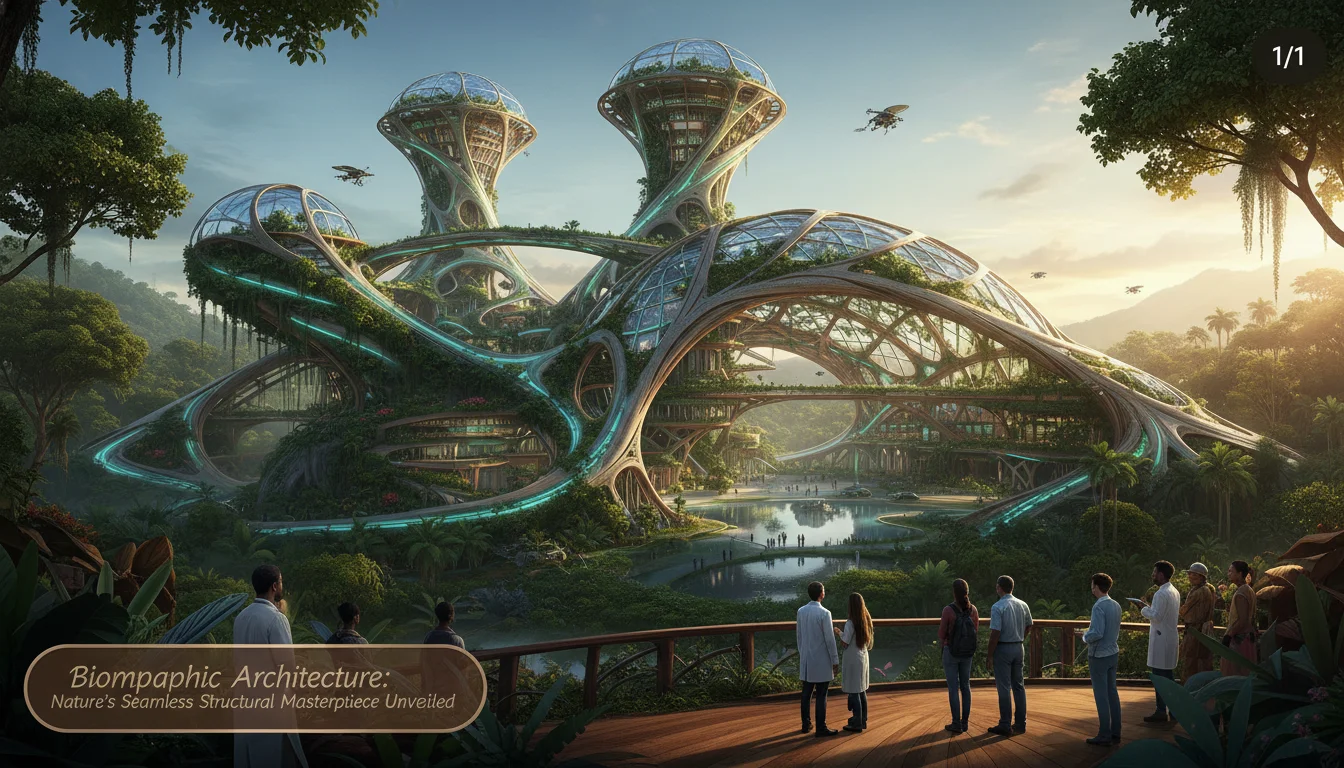
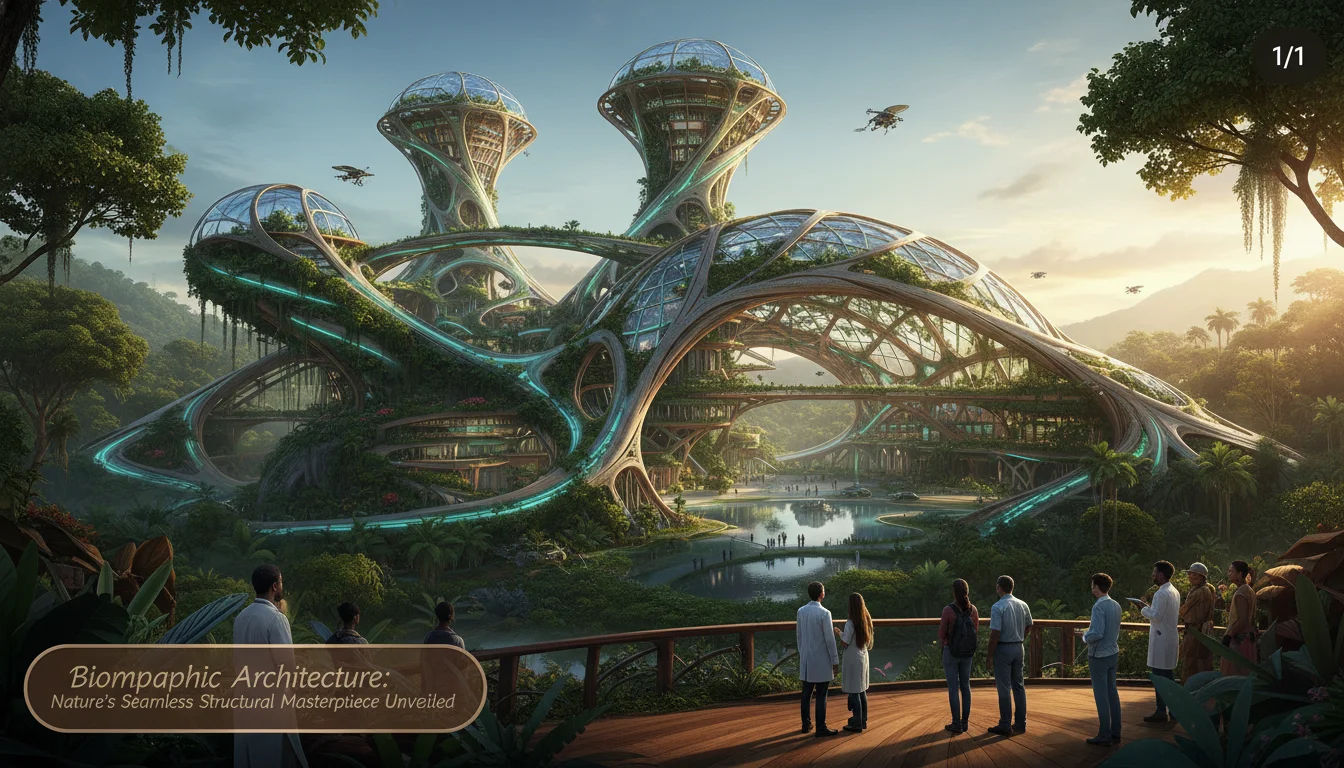
For millennia, humans have looked to the natural world for inspiration, for solace, and for solutions. It’s a truth as old as time. This deep-seated connection is perhaps most profoundly expressed in architecture, where the principles of biomorphism offer a blueprint for designs that are not only aesthetically pleasing but also remarkably efficient and resilient. We see it in the elegant curve of a seashell, the intricate branching of a tree, and the organic flow of a river. These forms, honed by millions of years of evolution, possess an inherent wisdom that architects are increasingly seeking to translate into built environments, aiming for a nature seamless structure that feels both ancient and revolutionary. This pursuit moves beyond mere imitation; it is about understanding the fundamental forces that shape life and applying them to create spaces that resonate with our deepest biological instincts.
Biomorphic Design: A Deep Dive
Biomorphic architecture is fundamentally about drawing inspiration from the shapes, patterns, and processes found in nature. It’s not just about slapping a leaf motif onto a building. Instead, it involves a profound investigation into the underlying principles of biological forms and functions. Think about how a bird’s nest is constructed for optimal strength and minimal material use, or how a honeycomb’s hexagonal cells provide maximum strength with minimum surface area. These are not random arrangements; they are the result of evolutionary pressures favoring efficiency and durability. Architects who embrace biomorphism aim to replicate these efficiencies, creating structures that are inherently stable, adaptable, and resource-conscious. This approach moves away from rigid, rectilinear designs and embraces fluidity, complexity, and organic growth, mirroring the very essence of living systems. It’s about understanding the ‘why’ behind nature’s forms, not just the ‘what’.
The Principles of Nature’s Design
Nature’s design lexicon is vast and incredibly sophisticated. One of its most striking features is its economy of material. Every element in a natural structure serves a purpose, and there is no excess. Consider the skeletal structure of a bone; it is hollow in parts yet incredibly strong, designed to withstand significant loads while remaining lightweight. This principle of optimized material usage is a cornerstone of biomorphic architecture. Furthermore, nature excels at creating complex geometries from simple rules. Fractal patterns, seen in coastlines, snowflakes, and tree branches, demonstrate how intricate structures can emerge from repetitive, self-similar processes. This inherent complexity allows for adaptability and resilience. A tree, for instance, can sway in the wind without breaking, its branching structure dissipating forces effectively. The ability to respond to environmental stimuli, a hallmark of living organisms, is another key principle. Buildings designed with biomorphic principles in mind might adapt to changing weather conditions, optimize natural light, or manage airflow efficiently, much like a plant tracks the sun or a mollusk forms its shell.
nature seamless structure 1
Structural Ingenuity in Nature
The structural ingenuity present in the natural world is nothing short of astonishing. Take the elephant’s leg, for example. Its bone structure is designed to support immense weight with minimal stress, a marvel of biological engineering. Similarly, the hollow, lightweight bones of birds enable flight, demonstrating how form and function are inextricably linked. These natural structures often exhibit exceptional strength-to-weight ratios, a goal that engineers and architects constantly strive to achieve. The way a spider spins its web, a delicate yet strong matrix, or how a mollusk builds its shell layer by layer, incrementally increasing its strength, are all lessons in efficient construction. These biological solutions have been refined over eons, providing a rich source of knowledge for creating more sustainable and robust buildings. The concept of a nature seamless structure is deeply embedded in these biological examples.
Early Examples and the Rise of Biomorphism
While the term “biomorphic architecture” might seem contemporary, the inspiration has been present in human construction for centuries, albeit less explicitly. Ancient Roman aqueducts, with their elegant arches, echo the natural curvature of a catenary, the shape a chain takes when suspended between two points. However, the conscious and systematic application of biomorphic principles gained significant traction in the 20th century. Architects like Antoni Gaudí, with his fluid, organic forms in works like the Sagrada Família, were pioneers. His work often drew direct inspiration from trees, bones, and shells, creating structures that felt alive. Later, architects like Eero Saarinen, with his TWA Flight Center, explored sweeping, aerodynamic forms that evoked the sensation of flight. These early explorations laid the groundwork for a more nuanced understanding of how biological forms could inform architectural design, moving beyond superficial resemblance to embrace underlying structural and functional logic.
Key Biomorphic Forms and their Applications
Several distinct biomorphic forms offer valuable insights for architects.
- The Shell: Think of the spiral shell of a nautilus. Its logarithmic spiral shape provides incredible strength and efficient space utilization. In architecture, this can translate into curved walls and domes that distribute stress evenly, such as in geodesic domes or certain stadium designs. The inherent self-supporting nature of a shell is a powerful concept.
- The Branching Structure: Trees are masters of efficient load distribution through their branching systems. This principle can be applied to structural supports, creating lighter and more efficient frameworks for buildings. Tree-like columns, for instance, can reduce the amount of material needed while maintaining structural integrity.
- The Honeycomb: The hexagonal structure of a honeycomb is renowned for its strength and efficiency. This geometric pattern is highly effective at distributing pressure and is used in lightweight, strong materials for aircraft and construction panels. Its modularity also offers design flexibility.
- The Bone: The porous yet strong structure of bone inspires designs that are both lightweight and capable of bearing significant loads. This can lead to innovative structural systems that mimic the trabecular bone structure, optimizing material use and reducing overall weight.
These forms, and many others found in nature, provide a rich vocabulary for architectural innovation, demonstrating a nature seamless structure that is both beautiful and functional.
nature seamless structure 2
Biomorphism and Sustainability
The alignment between biomorphic design and sustainability is one of its most compelling aspects. Nature, in its essence, is a highly efficient system that recycles and regenerates. By emulating its strategies, architects can create buildings that are inherently more environmentally responsible. The principle of material efficiency, as discussed earlier, directly leads to reduced resource consumption. Furthermore, biomorphic forms often lend themselves to passive design strategies. For instance, naturally curved surfaces can help optimize airflow, reducing the need for mechanical ventilation. Buildings inspired by leaves or flowers might be designed to capture sunlight for heating or to provide shade, minimizing energy demands. The adaptability of natural systems can also be translated into buildings that can be easily modified or repurposed, extending their lifespan and reducing waste. This holistic approach to design, where form, function, and environmental impact are considered together, is crucial for creating a more sustainable built environment. It’s about building in harmony with the planet, not against it.
Computational Design and Biomorphism
The advent of advanced computational design tools has significantly propelled the field of biomorphic architecture. Parametric modeling and generative design software allow architects to explore complex organic forms and test their structural performance in ways that were previously impossible. These tools can simulate natural growth processes, enabling the creation of highly optimized and intricate structures that mimic biological systems. For example, algorithms can be used to generate branching patterns for structural supports that respond to specific load-bearing requirements, much like a tree grows to optimize its exposure to sunlight and wind. This synergy between biology, mathematics, and digital technology allows for the creation of buildings that are not only inspired by nature but are also computationally designed for maximum efficiency and resilience. The digital realm provides a powerful means to translate the lessons of nature seamless structure into tangible architectural realities.
nature seamless structure 3
Case Studies in Biomorphic Architecture
Several contemporary projects vividly illustrate the principles of biomorphic architecture. The Eastgate Centre in Harare, Zimbabwe, designed by architect Mick Pearce, is a prime example. It draws inspiration from the self-cooling mounds built by termites. These mounds maintain a remarkably stable internal temperature despite extreme external fluctuations. The building’s innovative passive cooling system, which utilizes natural convection and thermal mass, significantly reduces energy consumption. Another notable example is the Eden Project in Cornwall, UK. Its biomes, large transparent enclosures housing diverse plant life, feature a complex geodesic structure that mimics natural cellular formations, providing a stable and controlled environment for the plants while minimizing material usage. The Bird’s Nest stadium in Beijing, for its distinctive external form, uses a lattice-like structure that evokes the appearance of a bird’s nest, showcasing how natural inspiration can lead to iconic architectural statements. These projects demonstrate the practical application of biomorphic principles, proving their viability and effectiveness.
The Future of Biomorphic Design
The trajectory of biomorphic architecture points towards increasingly sophisticated and integrated designs. As our understanding of biological systems deepens, so too will our ability to translate these principles into our built environments. We can anticipate structures that are not only inspired by nature but also actively interact with their surroundings, much like living organisms. This could involve buildings with self-healing materials, facades that adapt to light and temperature, or energy systems that mimic photosynthesis. The concept of a truly nature seamless structure will become more prevalent, blurring the lines between the natural and the built. Furthermore, as concerns about climate change and resource depletion grow, biomorphic design offers a vital pathway towards more sustainable and resilient cities. It represents a fundamental shift in our approach to building, moving from an extractive and often destructive relationship with the environment to one of integration and symbiosis. The ongoing exploration promises a future where our buildings are not just inert objects, but dynamic, responsive elements of the ecological system.