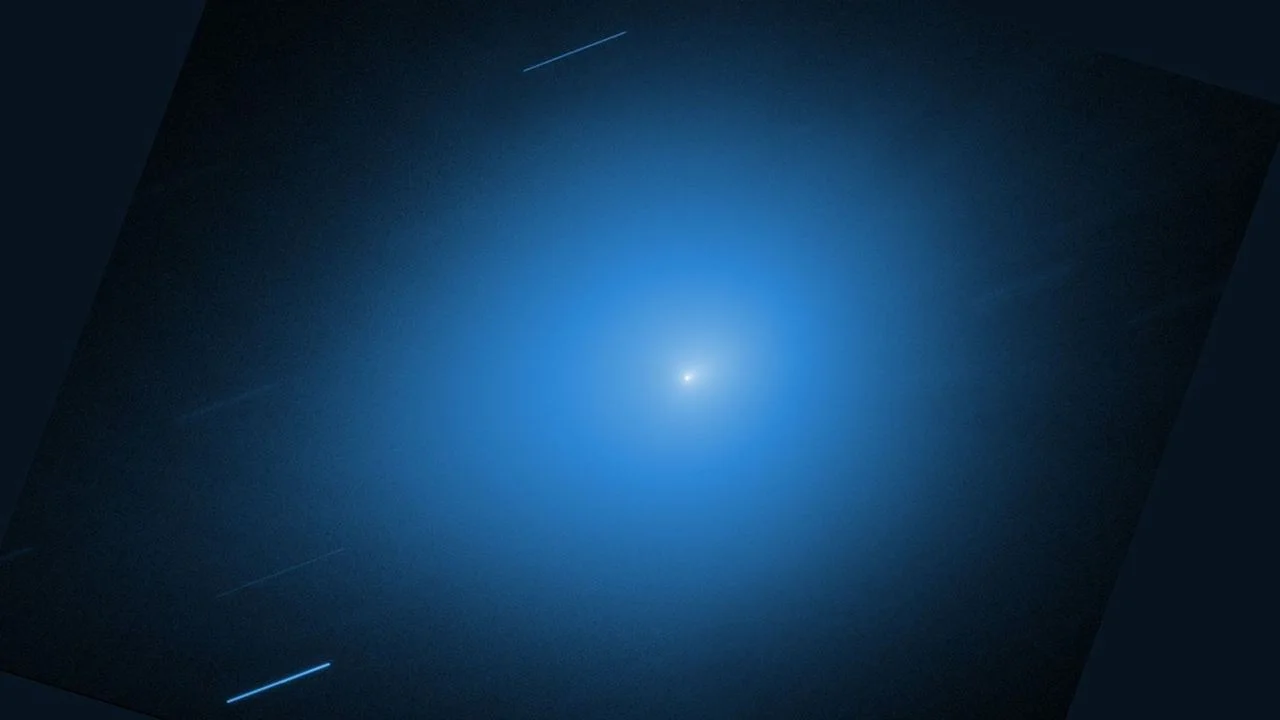
Comet 3I/ATLAS, the third interstellar object ever detected by astronomers, will make its closest approach to Earth overnight between Thursday and Friday (Dec. 18 to 19), when it gets to just 168 million miles (270 million kilometers) from our planet. It poses no threat to Earth.
The precise moment will come at 1 a.m. EST (0600 GMT) on Dec. 19, according to Space.com. Though still just under twice the distance from Earth as the sun — something that will preclude stunning photos from giant telescopes — it’s a unique opportunity to glimpse an object from another star system. Discovered in July 2025, it comes in the wake of 1I/’Oumuamua in 2017 and 2I/Borisov in 2019.
Comet 3I/ATLAS is now on its way away from the sun and out of the solar system, and by far the easiest way to see it before it departs will be online. Using its large telescopes in Manciano, Italy, the Virtual Telescope Project will host a free webcast on YouTube beginning at 11 p.m. EST on Dec. 18 (0400 GMT on Dec. 19). The webcast will also be available as a replay after the live event ends.
Another way to see comet 3I/ATLAS is with a GoTo or smart telescope. Any optical device with a motor can be trained on the object in the constellation Leo. The easiest method is via a smart telescope, such as the Seestar S50, Unistellar eVscope 2, Vaonis Vespera Pro or Celestron Origin; you should be able to find 3I/ATLAS in the app used to control any of these telescopes.
Any planetarium app — such as Sky Tonight, Sky Guide, Stellarium and SkySafari 7 Pro — will also have 3I/ATLAS in its database. That will be helpful to find it visually. Technically, it is visible in large astronomy binoculars, but at magnitude 11, it’s going to look “like a tiny, slightly out-of-focus star,” according to Sky at Night.
—’From another world’: 3I/ATLAS photobombs a galaxy and shows off its multiple tails in stunning new image
—Mars orbiter narrows down the exact path of interstellar comet 3I/ATLAS by ‘ten-fold,’ surprising scientists
—Astronomers detect first ‘radio signal’ from interstellar comet 3I/ATLAS — but it wasn’t aliens
A better way to view the comet is with a medium-to-large telescope of about 12 inches, according to NASA, through which observers may spot a faint, fuzzy patch of greenish light close to the bright star Regulus in Leo and a fainter companion, called Rho Leonis.
Get the world’s most fascinating discoveries delivered straight to your inbox.
In the meantime, astronomical telescopes on Earth and in space will continue to monitor it — some from much closer distances than we’ll get. Just today, NASA released new ultraviolet images of the comet taken with its Europa Clipper spacecraft from roughly 102 million miles (164 million km) away, closing the distance from Earth by about a third. Stay tuned for more NASA image releases after the close approach.
Jamie Carter is a Cardiff, U.K.-based freelance science journalist and a regular contributor to Live Science. He is the author of A Stargazing Program For Beginners and co-author of The Eclipse Effect, and leads international stargazing and eclipse-chasing tours. His work appears regularly in Space.com, Forbes, New Scientist, BBC Sky at Night, Sky & Telescope, and other major science and astronomy publications. He is also the editor of WhenIsTheNextEclipse.com.
You must confirm your public display name before commenting
Please logout and then login again, you will then be prompted to enter your display name.