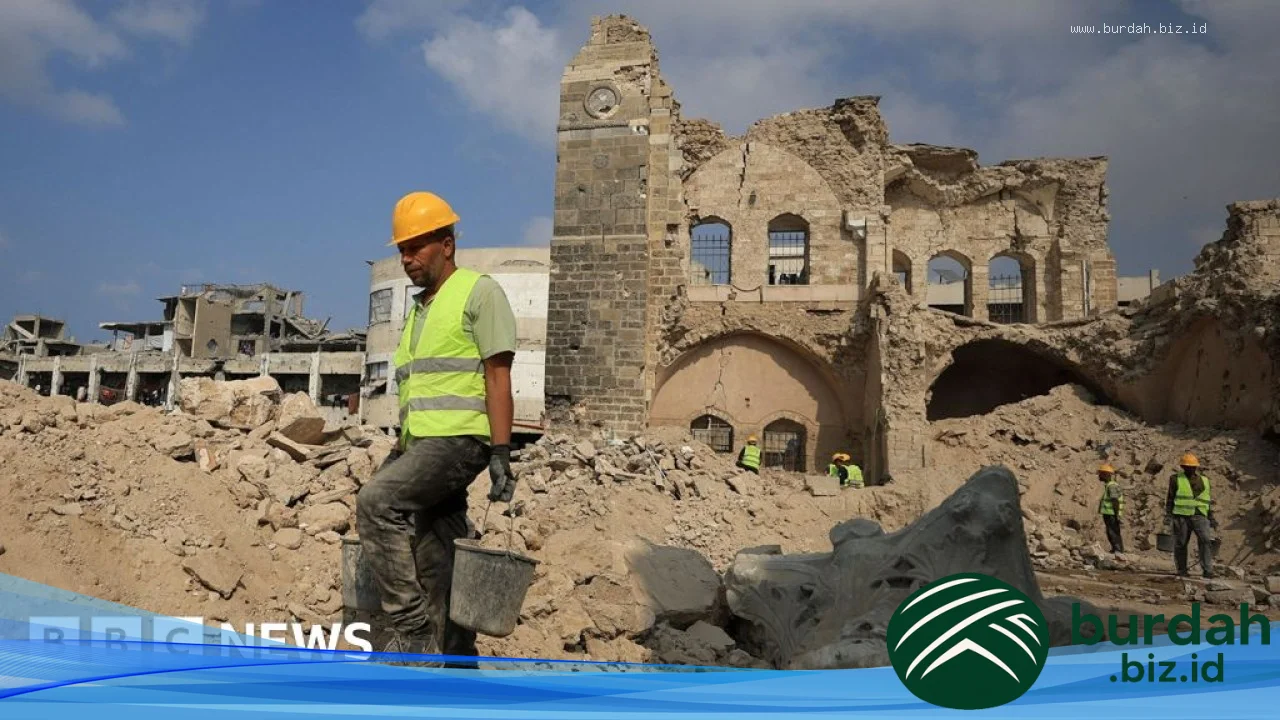
With pickaxes and wheelbarrows, dozens of Palestinian workers are carefully clearing rubble from the ruins of Gaza’s oldest mosque. The Great Omari Mosque, a medieval landmark, is now a shell of its former self. All that remains are a few external walls and the broken stump of its distinctive octagonal minaret after it was targeted by the Israeli military. Since a US-brokered ceasefire began, the slow process of sorting through the ancient stones has started, but true restoration is impossible for now. Israel is not permitting building supplies to enter Gaza, citing the terms of the truce agreement.
The Slow Work of Salvage
The teams on the ground face immense difficulties. They work with basic equipment, a stark contrast to the delicate nature of their task. The stones they handle are pieces of a history that stretches back over a millennium. This requires painstaking care.
“The challenges we face are first of all scarcity of resources – iron and construction materials,” says Hosni al-Mazloum, an engineer with the Palestinian cultural heritage organization Riwaq. “Then we’re using primitive tools… and being very careful because the stones here are 1,200 or 1,300 years old.”
This effort is not just about rebuilding a structure; it’s about piecing together a shattered identity. Gaza’s history is a deep and complex mix of cultures. Different civilizations have left their mark over 5,000 years.
- Canaanites
- Ancient Egyptians
- Philistines
- Assyrians and Persians
- Greeks and Jewish Hasmoneans
- Romans and Christian Byzantines
- Muslim Mamluks and Ottomans
First Aid for Ancient Manuscripts
Nearby, in a cramped Gaza City office, another form of cultural first aid is underway. Hanin al-Amsi, an internationally trained conservationist, pores over fragments of rare Islamic manuscripts recovered from the Great Omari Mosque’s 13th-century library. She leads a team, funded by the British Council, dedicated to saving these irreplaceable texts.
“Similar to how we perform first aid for people, we are doing it for the manuscripts,” Ms. Amsi explains.
The mission has been perilous. A young member of her department risked his life to retrieve some manuscripts while the Old City was under intense Israeli fire. Despite “catastrophic losses,” a remarkable 148 out of 228 manuscripts survived. This was largely thanks to pre-war preservation efforts with the British Library, which involved storing the works in acid-free boxes inside iron safes. Some pieces emerged almost unscathed. Others were reduced to charred scraps. Ms. Amsi confirms that the library’s main archive, a key record of Palestinian history with many Ottoman documents, was completely burned.
A Contested History
The destruction of these sites is a point of sharp contention. Palestinians accuse Israel of deliberately targeting their heritage, which would constitute a war crime. Israel rejects this claim, stating its actions comply with international law. The Israel Defense Forces (IDF) attribute the damage to Hamas, alleging the group operated “in the vicinity of, or beneath, cultural heritage sites.” Regarding the Great Omari Mosque, the IDF stated they bombed a tunnel shaft located there.
Third-party assessments confirm widespread damage. Using satellite imagery, Unesco has verified damage to 145 religious, historic, and cultural sites in Gaza since the conflict escalated on October 7, 2023. Local groups conducting surveys on the ground report a much higher level of destruction.
Echoes of Napoleon at Pasha’s Palace
The Great Omari Mosque is not an isolated case. Across Gaza City’s Old City, a team works to clear debris from the 800-year-old Pasha’s Palace. As they remove buckets of sand, the geometric patterns of a mosaic floor are slowly revealed. This historic fortress, where Napoleon Bonaparte stayed in 1799, had been converted into a museum displaying prized artifacts.
“We are dealing with a building that expresses the identity and memory of the Palestinian people,” says Dr. Hamouda al-Dahdar, a cultural heritage expert leading the effort. “We’re determined to preserve what’s left of this important landmark.”
Locals report the palace was hit by an Israeli airstrike and later bulldozed. The IDF stated it had no information about why the site was targeted. Of the 17,000 artifacts once housed there, most have been crushed or looted. So far, only about 30 have been recovered, including a piece of a Byzantine sarcophagus.
Global Support and Local Hurdles
This crucial work provides desperately needed jobs and is supported by international organizations. The Geneva-based Aliph Foundation has provided $700,000 for emergency work, while the British Council is assessing future heritage projects. Yet, significant barriers remain.
Many important archaeological sites are completely inaccessible. The leading Gazan archaeologist Fadel el-Otol, currently based in Switzerland, points to major locations now in areas under full Israeli control. These include Roman cemeteries and a Byzantine Church. Access to other sites, like the ancient Greek port of Anthedon, is blocked by camps for displaced people.
“There are many archaeological sites that we simply can’t reach because of the presence of the Israeli army,” Mr. Otol states. “We’re unable to assess the full extent of the internal damage.”
The future of Gaza remains deeply uncertain. Washington has signaled a push for progress on post-war governance and reconstruction. For many Gazans, the sight of workers carefully sifting through the ruins of their most iconic landmarks is a small, but powerful, sign of hope.