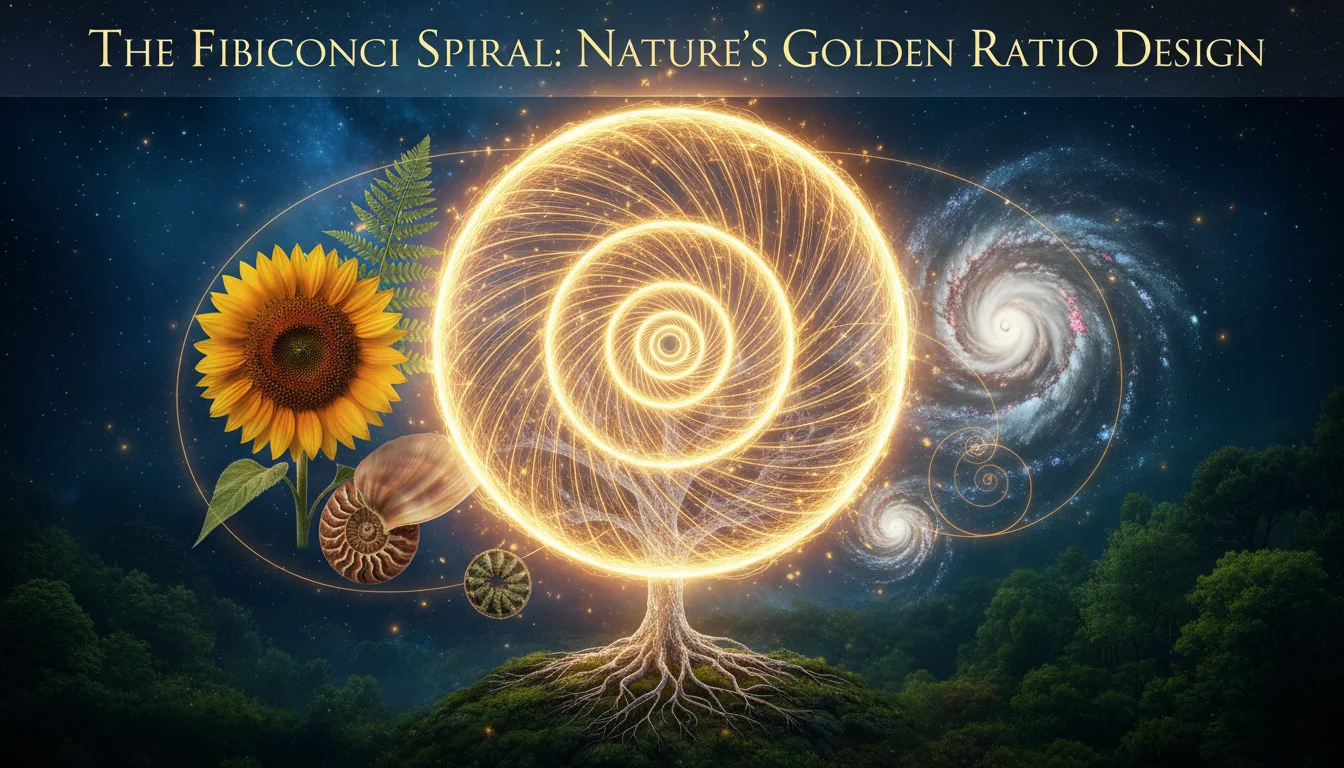
It’s everywhere. This elegant curve, this mathematical marvel, shapes our world in ways we often overlook. The Fibonacci spiral design isn’t just an abstract concept; it’s a foundational principle in nature’s architecture. This beautiful pattern, intrinsically linked to the Golden Ratio, appears in everything from the tiniest seashells to the grandest galaxies. Understanding this design offers a profound appreciation for the universe’s inherent order and aesthetic harmony.
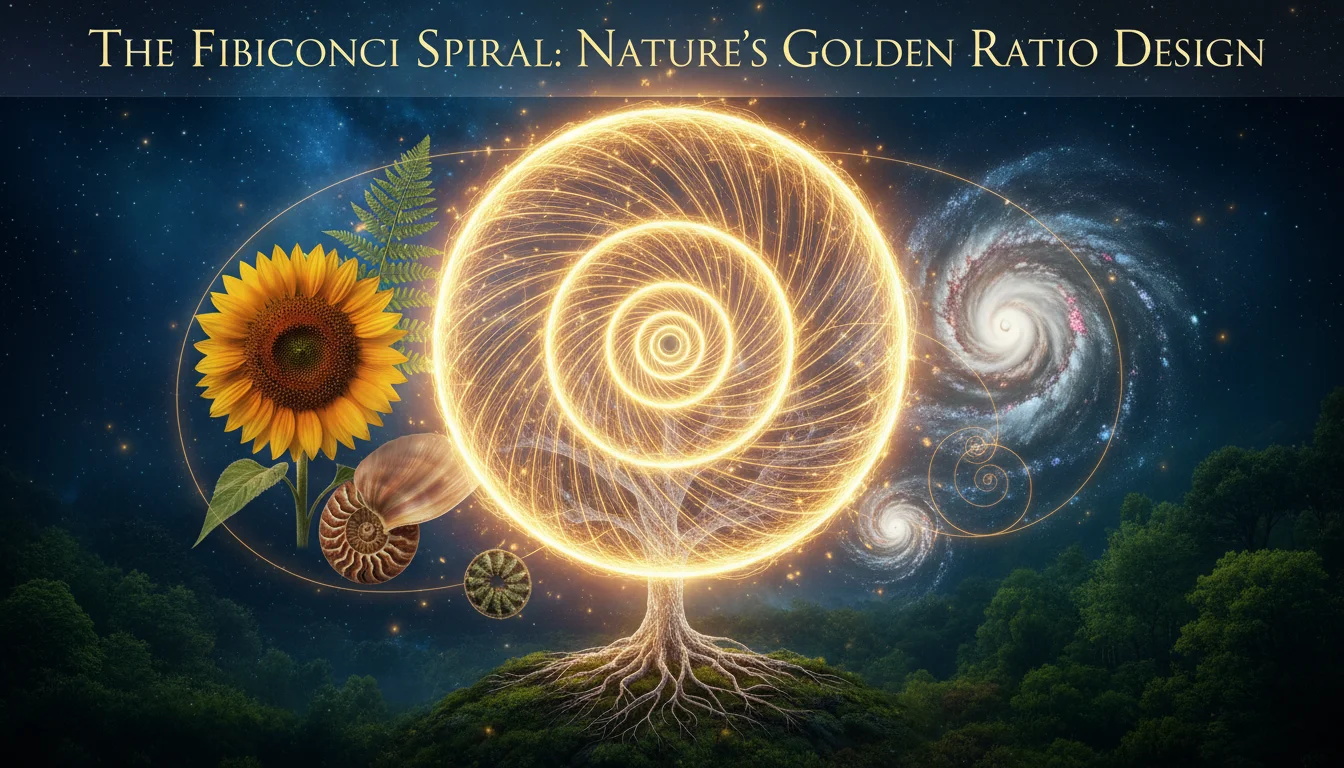
Nature’s Blueprint Unfolds
Honestly, just take a moment to look around. The way leaves unfurl on a stem, the arrangement of seeds in a sunflower, the swirl of a hurricane – these aren’t random occurrences. They are often dictated by a mathematical sequence. This sequence, known as the Fibonacci sequence, starts with 0 and 1, and each subsequent number is the sum of the two preceding ones: 0, 1, 1, 2, 3, 5, 8, 13, 21, and so on. It’s a simple progression, yet its implications are vast, leading directly to the creation of the Fibonacci spiral design.
The Golden Ratio Connection
Turns out, this sequence holds a secret. As you go further into the Fibonacci numbers, the ratio of any number to its preceding number gets closer and closer to approximately 1.618. This magical number is the Golden Ratio, often represented by the Greek letter phi (Φ). It’s a proportion that humans have found aesthetically pleasing for millennia, appearing in ancient art, architecture, and even our own bodies. The Fibonacci spiral design is essentially a visual representation of this ratio, creating a sense of balance and pleasing proportions.
Seashells: A Classic Example
Perhaps the most iconic illustration of the Fibonacci spiral design is found in the nautilus shell. As the creature grows, it adds new chambers, each one larger than the last, in a logarithmic spiral. If you were to overlay squares whose sides correspond to Fibonacci numbers onto a plane, and then draw a curve connecting the opposite corners of these squares, you would approximate the beautiful, expanding spiral seen in a nautilus shell. It’s a perfect example of growth following a mathematical principle.
Fibonacci spiral design 1
Floral Arrangements and Seeds
Step into a garden, and you’ll see this principle at play. Look at a sunflower’s face. The seeds are arranged in spirals, typically with one set of spirals curving clockwise and another counter-clockwise. The number of spirals in each direction is almost always a pair of consecutive Fibonacci numbers, like 34 and 55, or 55 and 89. This arrangement maximizes the number of seeds that can be packed into the head, ensuring efficient use of space. It’s a smart evolutionary design.
Pinecones exhibit a similar pattern. Their scales are arranged in intersecting spirals, and counting these spirals often reveals Fibonacci numbers. This efficient packing allows the pinecone to effectively protect its seeds and capture sunlight. The elegance of this solution is remarkable. It’s a clear demonstration of how mathematical order underpins biological efficiency.
Branching Trees and Leaf Arrangement
Even the way trees grow showcases the Fibonacci spiral design. Branches often emerge from a main trunk in a pattern that reflects the sequence. A main trunk might grow until it produces a branch, then continue to grow until it produces another, with the number of growing points at each stage often corresponding to Fibonacci numbers. This arrangement ensures that leaves receive optimal exposure to sunlight, minimizing overlap and maximizing photosynthesis.
The arrangement of leaves on a stem, known as phyllotaxis, is another area where this mathematical sequence is evident. Leaves are often positioned at specific intervals around the stem, determined by fractions involving Fibonacci numbers. For instance, a leaf might be positioned at 1/2 of a turn, 1/3, 2/5, 3/8, or 5/13 of a full circle from the previous leaf. This spacing is crucial for preventing leaves from shading each other, allowing each one to capture sunlight effectively.
Fibonacci spiral design 2
The Golden Angle and Spirals
The Fibonacci spiral design is closely related to the Golden Angle, which is approximately 137.5 degrees. This angle is derived from the Golden Ratio. When new elements, like seeds or leaves, are added at this angle, they distribute themselves evenly around a central point, creating the characteristic spiral patterns we observe. This angle ensures that no two elements are directly above one another, optimizing space and resource utilization. It’s a beautiful illustration of mathematical efficiency in nature.
Galaxies and Hurricanes: Cosmic Scales
The Fibonacci spiral design isn’t confined to the terrestrial. On a much grander scale, galaxies often display spiral arms that approximate a logarithmic spiral, a shape closely related to the Golden Ratio. While the exact physics are complex, the emergent patterns resonate with this fundamental mathematical principle. It suggests that the universe itself may operate on principles of elegant mathematical order.
Similarly, hurricanes and other storm systems frequently form spiral patterns that mirror this design. The swirling clouds and wind currents tend to arrange themselves in a way that is mathematically predictable, following a logarithmic curve. This phenomenon highlights how recurring mathematical patterns can manifest across vastly different scales of the universe.
Human Anatomy and Aesthetics
It’s fascinating to consider that this pattern might even be present within us. The proportions of the human body, from the ratio of arm length to forearm length to the arrangement of bones in our fingers, have been suggested to align with the Golden Ratio. While it’s difficult to prove definitively, many artists and designers believe that incorporating these proportions leads to more aesthetically pleasing and harmonious creations. The human eye seems to be predisposed to find beauty in these mathematical relationships.
Art, Architecture, and the
Throughout history, artists and architects have intuitively or deliberately incorporated the Golden Ratio and its spiral form into their work. The Parthenon in Greece, for example, is often cited as an example of Golden Ratio proportions. Renaissance artists like Leonardo da Vinci are believed to have used these principles to create compositions that felt balanced and natural. The appeal of the lies in its inherent sense of order and harmony, which resonates deeply with our perception of beauty.
3
Modern design also frequently leverages this principle. From graphic design and web layout to product design, the Golden Ratio and its associated spiral can be used to create visually appealing compositions that guide the viewer’s eye and create a sense of balance. It’s a tool that helps designers achieve a pleasing aesthetic. The provides a framework for creating visually engaging content.
The Mathematical Foundation
Let’s revisit the sequence itself. If we draw squares with sides corresponding to Fibonacci numbers (1×1, 1×1, 2×2, 3×3, 5×5, 8×8, and so on) and arrange them in a spiral pattern, we can then draw a smooth curve that connects the opposite corners of these squares. This curve is the Fibonacci spiral. Each step outward is larger than the last, creating an ever-expanding yet proportionally consistent spiral. It’s a visually stunning demonstration of the sequence’s power.
The beauty of this mathematical construction is its simplicity and its profound ability to describe complex natural phenomena. It’s a reminder that beneath the apparent chaos of nature, there often lies a deep, underlying order governed by elegant mathematical principles. The is a key to understanding this order.
Why This Pattern Persists
So, why is this so prevalent? The primary reason is efficiency. Nature favors designs that maximize resource utilization, whether it’s sunlight for plants, space for seeds, or energy for animal growth. The logarithmic spiral, which the Fibonacci sequence approximates, is exceptionally efficient at filling space and growing outward without significant gaps or overlaps. It’s a highly optimized form.
This efficiency translates into survival and reproductive success. Organisms that are better at capturing sunlight, packing seeds, or growing stronger structures are more likely to thrive. The , therefore, isn’t just aesthetically pleasing; it’s a practical, evolutionary advantage. It’s a testament to nature’s ingenious problem-solving abilities.
4
Learning from Nature’s Design
By studying the , we gain insights into the fundamental principles that govern growth and form in the natural world. This understanding can inspire innovation in various fields, from engineering and architecture to art and computer science. It encourages us to look to nature as a source of elegant and efficient solutions. The offers a powerful model.
The next time you see a fern unfurling, a pinecone on the forest floor, or even a distant galaxy, consider the mathematical elegance at play. The is a constant reminder of the interconnectedness of mathematics, nature, and beauty. It’s a universal language written in the curves of the universe, speaking of order, harmony, and profound efficiency.