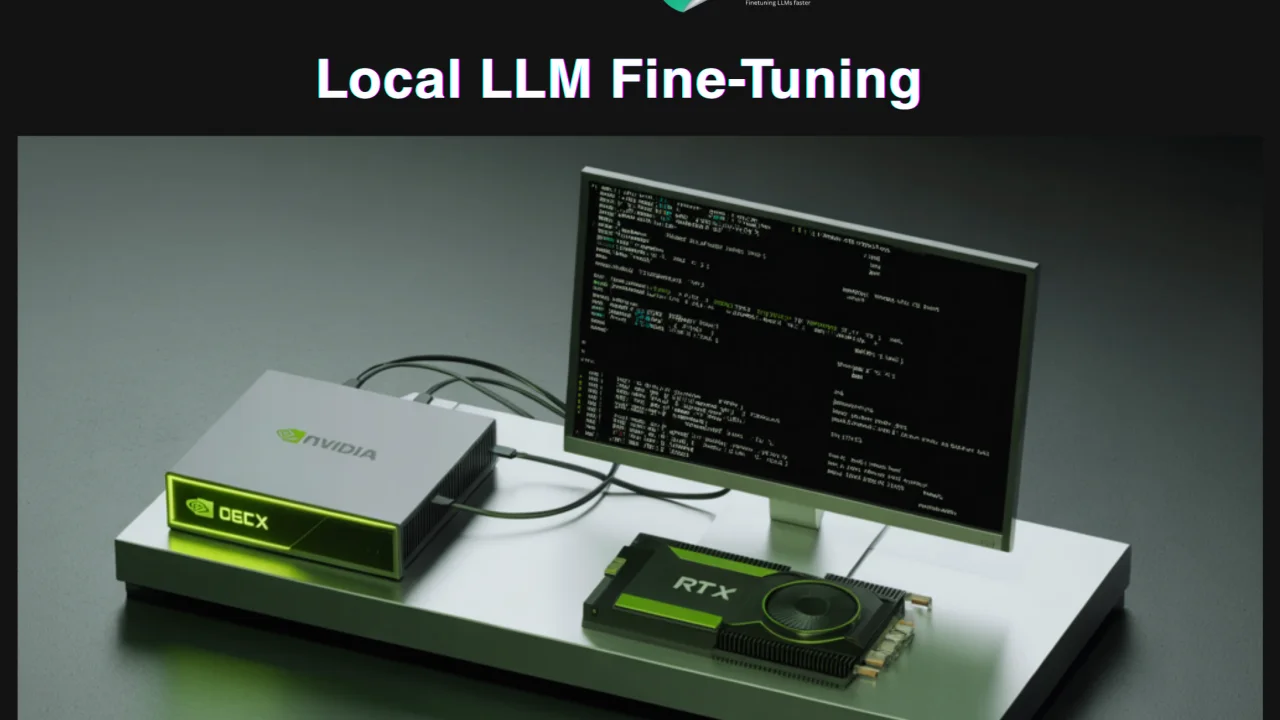
The landscape of modern AI is shifting. We are moving away from a total reliance on massive, generalized cloud models and entering the era of local, agentic AI. Whether it is tuning a chatbot to handle hyper-specific product support or building a personal assistant that manages intricate schedules, the potential for generative AI on local hardware is boundless.
However, developers face a persistent bottleneck: How do you get a Small Language Model (SLM) to punch above its weight class and respond with high accuracy for specialized tasks?
The answer is Fine-Tuning, and the tool of choice is Unsloth.
Unsloth provides an easy and high-speed method to customize models. Optimized for efficient, low-memory training on NVIDIA GPUs, Unsloth scales effortlessly from GeForce RTX desktops and laptop all the way to the DGX Spark, the world’s smallest AI supercomputer.
Think of fine-tuning as a high-intensity boot camp for your AI. By feeding the model examples tied to a specific workflow, it learns new patterns, adapts to specialized tasks, and dramatically improves accuracy.
Depending on your hardware and goals, developers generally utilize one of three main methods:
One of the most critical factors in local fine-tuning is Video RAM (VRAM). Unsloth is magic, but physics still applies. Here is the breakdown of what hardware you need based on your target model size and tuning method.
This is where most hobbyists and individual developers will live.
For when you need total control over the model weights.
The cutting edge of agentic behavior.
Why is Unsloth winning the fine-tuning race? It comes down to math.
LLM fine-tuning involves billions of matrix multiplications, the kind of math well suited for parallel, GPU-accelerated computing. Unsloth excels by translating the complex matrix multiplication operations into efficient, custom kernels on NVIDIA GPUs. This optimization allows Unsloth to boost the performance of the Hugging Face transformers library by 2.5x on NVIDIA GPUs.
By combining raw speed with ease of use, Unsloth is democratizing high-performance AI, making it accessible to everyone from a student on a laptop to a researcher on a DGX system.
The Goal: Take a base model (like Llama 3.2 ) and teach it to respond in a specific, high-value style, acting as a mentor who explains complex topics using simple analogies and always ends with a thought-provoking question to encourage critical thinking.
The Problem: Standard system prompts are brittle. To get a high-quality “Mentor” persona, you must provide a 500+ token instruction block. This creates a “Token Tax” that slows down every response and eats up valuable memory. Over long conversations, the model suffers from “Persona Drift,” eventually forgetting its rules and reverting to a generic, robotic assistant. Furthermore, it is nearly impossible to “prompt” a specific verbal rhythm or subtle “vibe” without the model sounding like a forced caricature.
The Solution: sing Unsloth to run a local QLoRA fine-tune on a GeForce RTX GPU, powered by a curated dataset of 50–100 high-quality “Mentor” dialogue examples. This process “bakes” the personality directly into the model’s neural weights rather than relying on the temporary memory of a prompt.
The Result: A standard model might miss the analogy or forget the closing question when the topic gets difficult. The fine-tuned model acts as a “Native Mentor.” It maintains its persona indefinitely without a single line of system instructions. It picks up on implicit patterns, the specific way a mentor speaks, making the interaction feel authentic and fluid.
To see the power of local fine-tuning, look no further than the banking sector.
The Problem: Banks run on ancient code (COBOL, Fortran). Standard 7B models hallucinate when trying to modernize this logic, and sending proprietary banking code to GPT-4 is a massive security violation.
The Solution: Using Unsloth to fine-tune a 32B model (like Qwen 2.5 Coder) specifically on the company’s 20-year-old “spaghetti code.”
The Result: A standard 7B model translates line-by-line. The fine-tuned 32B model acts as a “Senior Architect.” It holds entire files in context, refactoring 2,000-line monoliths into clean microservices while preserving exact business logic, all performed securely on local NVIDIA hardware.
While text is powerful, the next frontier of local AI is Vision. Medical institutions sit on mountains of imaging data (X-rays, CT scans) that cannot legally be uploaded to public cloud models due to HIPAA/GDPR compliance.
The Problem: Radiologists are overwhelmed, and standard Vision Language Models (VLMs) like Llama 3.2 Vision are too generalized, identifying a “person” easily, but missing subtle hairline fractures or early-stage anomalies in low-contrast X-rays.
The Solution: A healthcare research team utilizes Unsloth’s Vision Fine-Tuning. Instead of training from scratch (costing millions), they take a pre-trained Llama 3.2 Vision (11B) model and fine-tune it locally on an NVIDIA DGX Spark or dual-RTX 6000 Ada workstation. They feed the model a curated, private dataset of 5,000 anonymized X-rays paired with expert radiologist reports, using LoRA to update vision encoders specifically for medical anomalies.
The Outcome: The result is a specialized “AI Resident” operating entirely offline.
Here is the technical breakdown of how to build this solution using Unsloth based on the Unsloth documentation.
For a tutorial on how to fine-tune vision models using Llama 3.2 click here.
Unsloth and NVIDIA have provided comprehensive guides to get you running immediately.
Thanks to the NVIDIA AI team for the thought leadership/ Resources for this article. NVIDIA AI team has supported this content/article.
Jean-marc is a successful AI business executive .He leads and accelerates growth for AI powered solutions and started a computer vision company in 2006. He is a recognized speaker at AI conferences and has an MBA from Stanford.