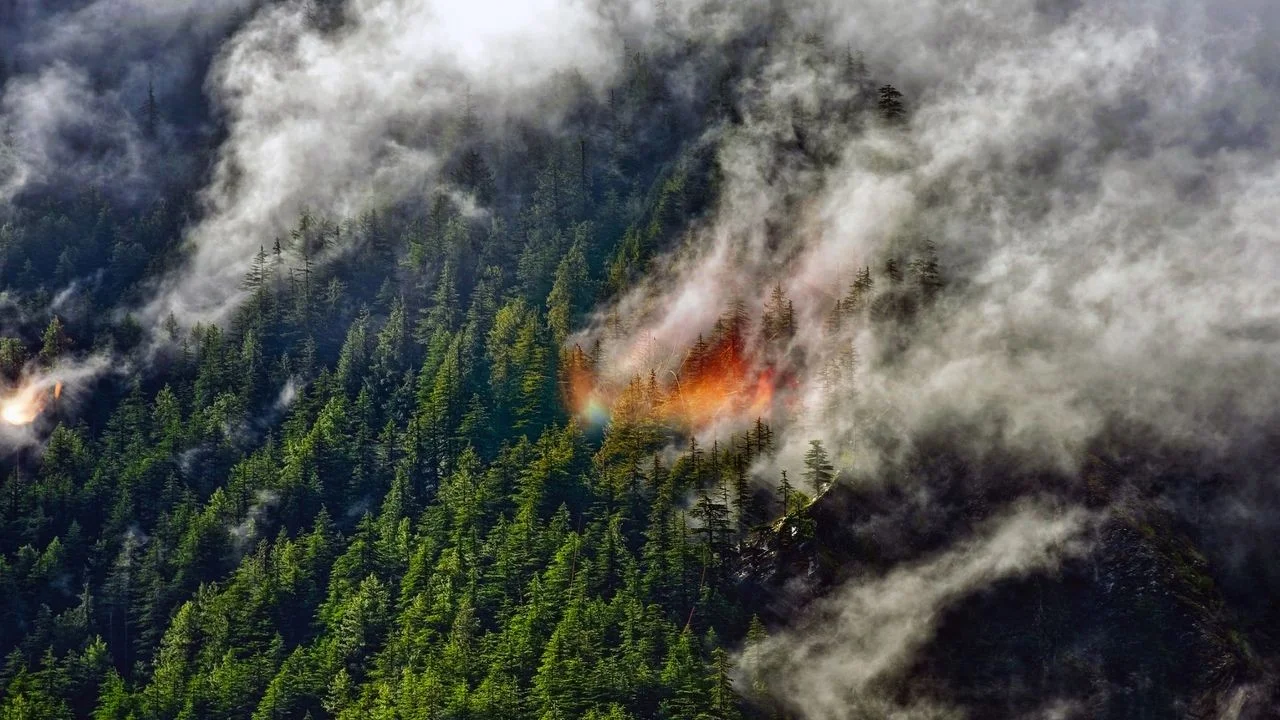
SAN FRANCISCO (WHN) – Wildfires, long understood as destructive forces on the ground, are now revealing a more insidious impact: they’re actively altering Earth’s upper atmosphere and, by extension, its climate. New research from the Harvard John A. Paulson School of Engineering and Applied Sciences has provided the first direct measurements of smoke particles lofted to extreme altitudes, revealing they behave differently and possess a climate effect not currently accounted for in our models.
These aren’t your typical smoke plumes drifting lazily overhead. Some of the most intense wildfires are so powerful they generate pyrocumulonimbus thunderstorms, essentially self-made weather systems. These phenomena can push smoke an astonishing 10 miles (16 kilometers) into the atmosphere, a region where it can linger for weeks, or even months.
The challenge has always been getting direct, timely data from these high-altitude clouds. Collecting samples from such heights is notoriously difficult, leaving a blind spot in our understanding of their climatic influence. That is, until a NASA ER-2 high-altitude aircraft took to the skies in June 2022.
Five days after a New Mexico wildfire ignited, the aircraft, equipped with specialized instruments, flew directly into the resulting smoke plume. The mission’s goal: to measure the smoke’s particle size, concentration, and chemical makeup while it was still relatively fresh.
What the scientists found was significant. Within the smoke cloud, they detected aerosols approximately 500 nanometers wide. This is roughly twice the size of the wildfire aerosols typically observed at lower altitudes. The researchers suggest this larger size is a product of efficient coagulation.
Yaowei Li, the study’s lead author, explained the phenomenon. “Particles can coagulate at any place in the atmosphere,” he stated. “But in that specific region, the air mixes very slowly. That allows wildfire smoke particles to remain concentrated and collide more often, making coagulation much more efficient.”
These aerosols, regardless of their altitude, play a crucial role in regulating how much solar radiation reaches Earth’s surface. They can either absorb sunlight or reflect it back into space. The striking finding here is that these larger, high-altitude particles from wildfire smoke demonstrated a measurable cooling effect.
Specifically, the study reported that these larger particles increased outgoing radiation by 30% to 36% compared to their lower-altitude counterparts. This suggests a significant cooling influence that current climate models, which likely don’t account for these large, coagulated particles, are missing.
The implications are far-reaching, though more research is clearly needed. Study co-author John Dykema pointed to potential impacts on atmospheric circulation. The localized heating caused by these large smoke particles could, he suggests, alter large-scale weather patterns, potentially even shifting jet streams. “I think all of these things are possible, and we don’t currently have enough information to say which way they could go,” Dykema noted.
The study, published on December 10th in the journal Science Advances, marks a critical step in understanding the complex feedback loops between extreme weather events like wildfires and the broader climate system. It highlights how events we once saw as purely terrestrial can have profound, and until now, unquantified, effects on the global atmosphere.