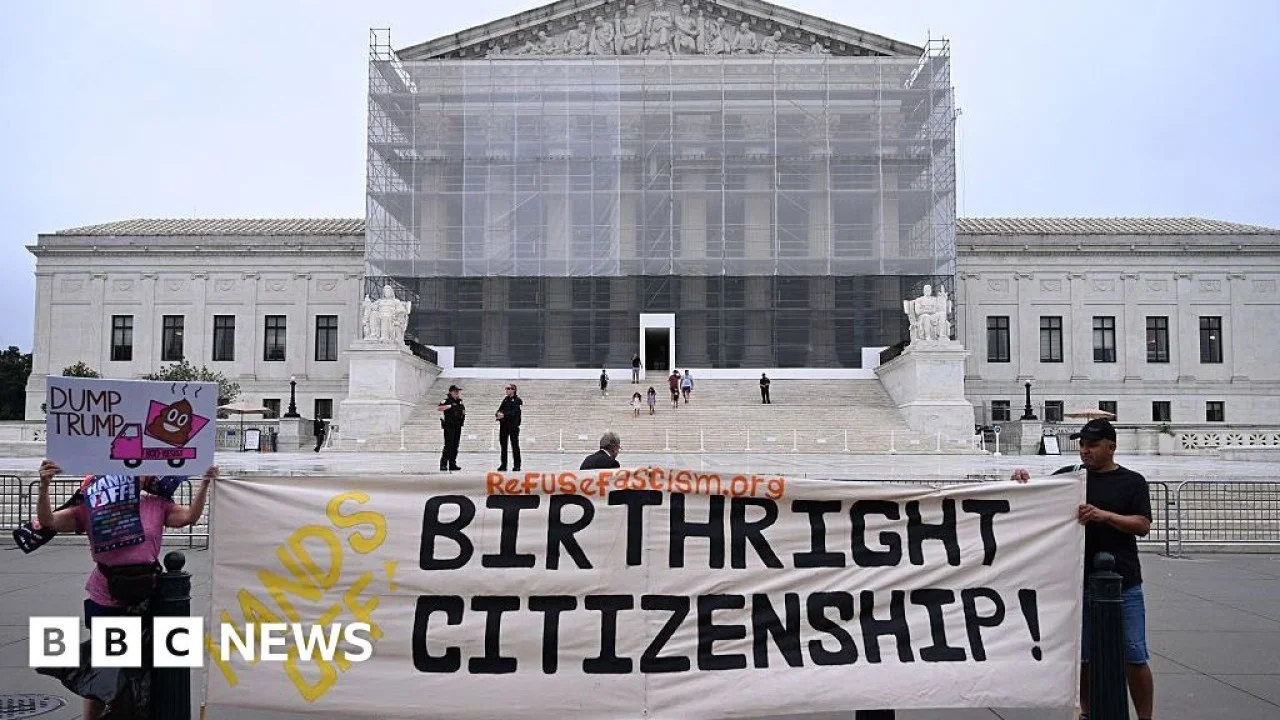
Supreme Court Weighs Birthright Citizenship
The United States Supreme Court has formally agreed to hear a pivotal case that will determine the constitutional right to citizenship for certain children born within the nation’s borders. This significant development follows an executive order issued by President Donald Trump on his first day in office, which aimed to terminate birthright citizenship for children born to parents residing in the U.S. illegally. Consequently, lower courts had previously blocked the implementation of this order, necessitating the Supreme Court’s intervention to settle the complex legal question.
While a specific date for oral arguments has not yet been scheduled, and a definitive ruling is anticipated to be months away, the Court’s eventual decision could profoundly impact the landscape of immigration enforcement and the fundamental definition of American citizenship. For approximately 160 years, the 14th Amendment to the U.S. Constitution has firmly established the principle that any individual born within the United States is automatically a citizen, with very limited exceptions, such as children of foreign diplomats or military personnel stationed in the U.S.
The precise language of this amendment states: “All persons born or naturalized in the United States, and subject to the jurisdiction thereof, are citizens of the United States.” President Trump’s executive order, however, seeks to exclude children born to parents who are either present in the U.S. without authorization or are on temporary visas from this automatic grant of citizenship. This measure is presented as a component of the administration’s broader strategy to reform the nation’s immigration system and address what they have characterized as substantial threats to national security and public safety.
The administration’s legal argument hinges on the interpretation of the phrase “subject to the jurisdiction thereof” within the 14th Amendment. They contend that this clause implicitly excludes children whose parents are not in the country permanently or lawfully. Conversely, legal experts and civil rights organizations strongly oppose this interpretation. Cecillia Wang, the national legal director for the American Civil Liberties Union, which is representing the plaintiffs in this case, has asserted that no president possesses the authority to alter the foundational promise of citizenship enshrined in the 14th Amendment. As she stated, “For over 150 years, it has been the law and our national tradition that everyone born on U.S. soil is a citizen from birth.” She further expressed anticipation for the issue to be definitively resolved by the Supreme Court.
It is noteworthy that the United States is among a limited number of countries, primarily in the Americas, that extend automatic citizenship to all individuals born within their territories. Following the challenges brought forth against President Trump’s executive order, several federal judges ruled that it contravened the Constitution. Moreover, two federal circuit courts of appeals upheld injunctions that prevented the order from taking effect. Subsequently, President Trump appealed to the Supreme Court to contest these injunctions. In a prior development, the Court ruled in June that the injunctions issued by the lower courts had exceeded their authority, though this decision did not directly address the core question of birthright citizenship itself.
The 14th Amendment was adopted in the aftermath of the American Civil War, with the express purpose of clarifying the citizenship status of formerly enslaved individuals born in the United States. U.S. Solicitor General D. John Sauer has argued that the amendment was intended to grant citizenship to newly freed slaves and their descendants, rather than to the children of individuals who were temporarily visiting or residing in the United States unlawfully. He has characterized the notion that birth on U.S. soil automatically confers citizenship as a “mistaken view” that has resulted in “destructive consequences.”
Statistical data provides context for the scale of this issue. According to The Pew Research Center, approximately 250,000 babies were born to parents without authorization in the U.S. in 2016, marking a significant decrease from its peak in 2007. More recently, by 2022, Pew reported that 1.2 million U.S. citizens were born to unauthorized immigrant parents. Furthermore, a study by the Migration Policy Institute and Pennsylvania State University’s Population Research Institute suggests that revoking birthright citizenship could lead to a substantial increase in the unauthorized population, potentially by an additional 2.7 million by 2045 and 5.4 million by 2075.