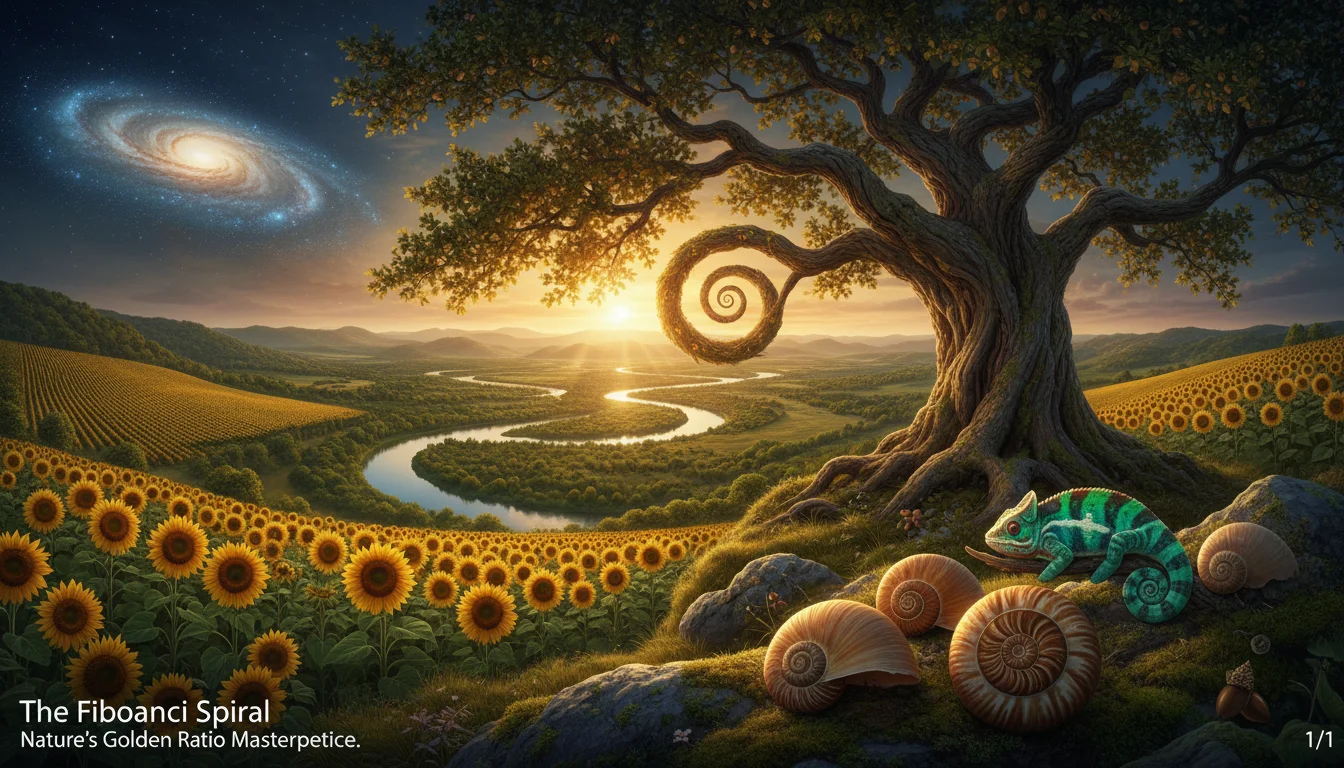
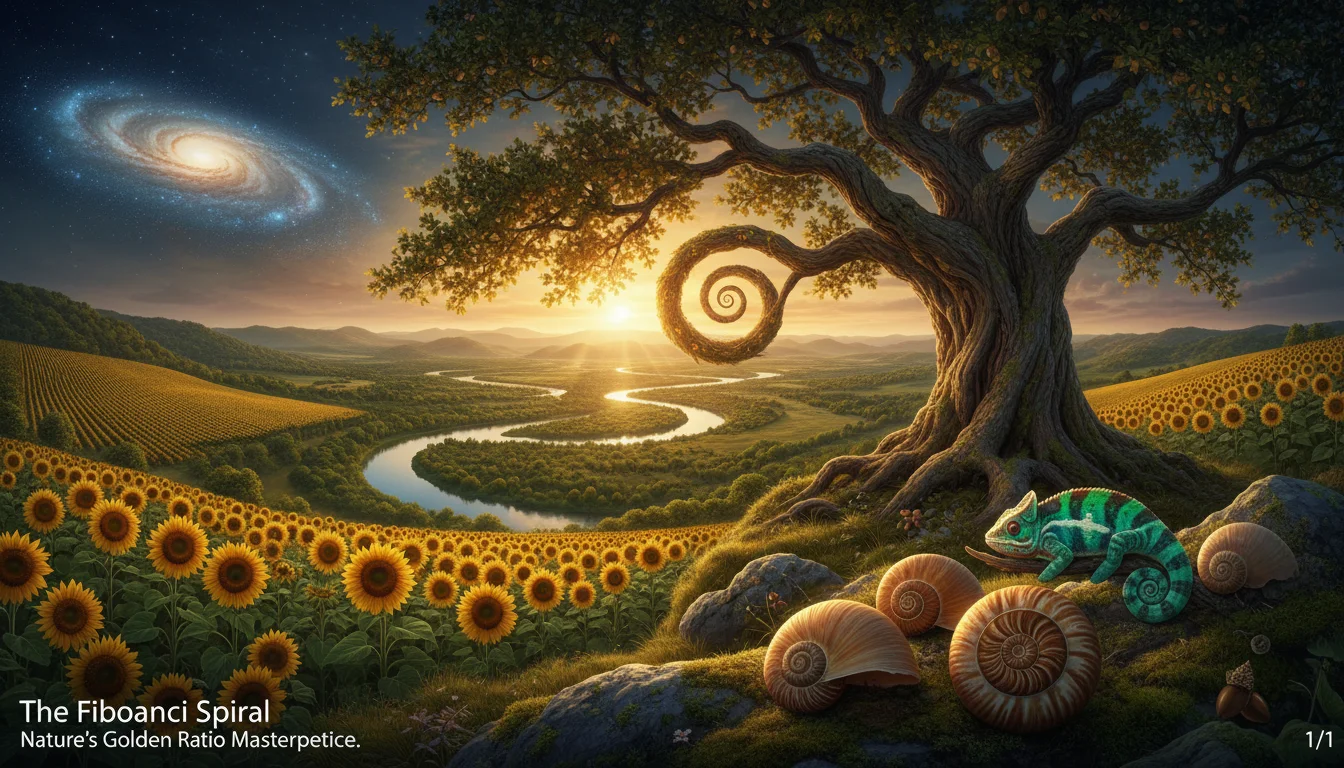
This perfect curve, the Fibonacci spiral nature, shows up everywhere. It’s not just a pretty pattern; it’s a mathematical marvel woven into the fabric of our world. Honestly, once you start looking, you can’t unsee it. It’s a sequence of numbers, 0, 1, 1, 2, 3, 5, 8, 13, 21, and so on, where each number is the sum of the two preceding ones. This simple rule generates a profound beauty. Turns out, this sequence is linked to the Golden Ratio, often represented by the Greek letter phi (φ), approximately 1.618. The ratio of successive Fibonacci numbers gets closer and closer to phi as the numbers get larger. This relationship is the secret sauce behind the spiral’s pleasing proportions.
The Golden Ratio’s Influence
The Golden Ratio, and by extension the Fibonacci sequence, has captivated artists, architects, and thinkers for centuries. Its presence in art and architecture is often cited as a reason for their aesthetic appeal. Think of the Parthenon, or the Mona Lisa’s composition. While some of these attributions are debated, the enduring fascination with these proportions is undeniable. The way the spiral expands, maintaining a consistent growth factor, creates a sense of harmony and balance that our eyes naturally find agreeable. It’s a visual language of sorts, speaking of order and efficiency.
Nature’s Masterful Design
Nature, in its infinite wisdom, seems to have a fondness for this particular mathematical construct. The Fibonacci spiral nature isn’t an isolated phenomenon; it’s a recurring motif across diverse biological forms. This suggests that these proportions offer a distinct evolutionary advantage, promoting efficient growth and resource utilization. It’s a testament to the elegance of natural selection, favoring designs that are both functional and beautiful. The underlying mathematical principles guide the development of structures, leading to optimized arrangements.
Fibonacci spiral nature 1
Seeds in a Sunflower
One of the most striking examples of the Fibonacci spiral nature is found in the arrangement of seeds in a sunflower head. Observe a sunflower closely. You’ll notice that the seeds are arranged in two sets of spirals, curving in opposite directions. Count these spirals, and you’ll almost invariably find numbers that are consecutive in the Fibonacci sequence, like 34 and 55, or 55 and 89. This arrangement isn’t accidental. It allows the sunflower to pack the maximum number of seeds into the available space, ensuring efficient reproduction. Each seed gets its own optimal spot, without much wasted room. This packing efficiency is a key benefit. This pattern maximizes sunlight exposure for each developing seed. It’s a brilliant solution to a biological challenge, all thanks to a simple numerical relationship.
Petals on a Flower
The number of petals on many flowers also frequently aligns with Fibonacci numbers. Lilies often have three petals, buttercups five, delphiniums eight, marigolds thirteen, asters twenty-one, and daisies often thirty-four, fifty-five, or eighty-nine. While not every flower adheres strictly to this rule, the prevalence is significant enough to warrant attention. This suggests a possible link between petal arrangement and pollination efficiency, or perhaps a developmental constraint related to how flower buds form. The growth process favors these numbers. It’s another instance where nature seems to operate by elegant mathematical principles. This pattern provides a certain symmetry. It makes the flower more attractive to pollinators. The consistent emergence of these numbers is truly remarkable.
The Unfurling of a Fern Frond
When a fern frond begins to grow, it unfurls in a characteristic coiled shape known as a fiddlehead. This coiling often follows a logarithmic spiral, closely resembling the Fibonacci spiral. As the frond matures and grows, it straightens out. This process ensures that the delicate new growth is protected during its vulnerable early stages. The spiral shape allows for compact storage of the developing leaf. It’s a practical adaptation for protection and efficient growth. The tightly wound structure shields the nascent leaf. It prevents damage from external elements. As it grows, it expands outwards. This unfolding is a beautiful visual representation of growth following a mathematical blueprint.
Fibonacci spiral nature 2
The Shell of a Nautilus
Perhaps the most iconic representation of the Fibonacci spiral nature is the shell of the nautilus. As the nautilus grows, it adds new chambers to its shell. Each new chamber is roughly 1.618 times larger than the previous one, perfectly mirroring the Golden Ratio and the growth of the Fibonacci spiral. This creates a shell that is both aesthetically pleasing and structurally sound. The chambers provide buoyancy control for the creature. They offer protection. The chamber progression is incredibly precise. It’s a living embodiment of this mathematical principle. The shell expands consistently. It maintains its perfect proportions throughout the creature’s life. This growth pattern is a marvel of natural engineering. The chambers are added sequentially. Each is a scaled version of the last.
Pinecones and Pineapples
The scales on a pinecone and the segments on a pineapple also exhibit Fibonacci numbers. Look closely at a pinecone. You will see spirals running in different directions. Often, the number of spirals in each direction will be consecutive Fibonacci numbers. The same holds true for the hexagonal segments of a pineapple. This arrangement optimizes the packing of seeds (in pinecones) or fruitlets (in pineapples), ensuring maximum exposure to sunlight and efficient use of space. It’s a pattern that promotes survival and reproduction. The structure is compact and efficient. This arrangement allows for optimal light capture. It facilitates even ripening. The spiral arrangement is key to their form. It’s a clear demonstration of mathematical order. These structures are not random. They are guided by underlying numerical principles.
The Spiral Galaxy
Extending beyond our planet, the Fibonacci spiral nature even appears in the grandest structures of the universe. The arms of spiral galaxies, like our own Milky Way, often approximate a logarithmic spiral, which is mathematically linked to the Golden Ratio. While the forces at play in galaxies are vastly more complex than those governing a sunflower’s seeds, the recurring presence of this spiral shape suggests fundamental principles of growth and form may be universal. It’s humbling to think that the same mathematical beauty found in a tiny shell can be observed in celestial bodies spanning light-years. This connection is awe-inspiring. It bridges the microscopic and the cosmic. The spiral form is an efficient way to organize mass. It allows for the distribution of stars and gas. This shape is a common outcome in astrophysical processes.
Fibonacci spiral nature 3
Why This Pattern? Efficiency and Growth
The persistent appearance of the Fibonacci spiral nature across so many different natural phenomena points to its inherent efficiency. In botany, this arrangement maximizes sunlight exposure for leaves and seeds, aids in pollination, and allows for compact growth. In zoology, as seen with the nautilus, it provides a strong, efficiently growing shell. The mathematical properties of the Golden Ratio and the Fibonacci sequence lend themselves to solutions that are both robust and resource-conscious. Nature tends to favor solutions that work best. This spiral pattern is a prime example of such an optimal solution. It’s a design that has been refined over millions of years of evolution. The efficiency is not just aesthetic; it’s functional. It directly contributes to the organism’s survival and reproductive success. It’s a principle of optimal packing and growth. This makes the truly remarkable.
Human Perception and the Golden Ratio
Our own perception of beauty may be subconsciously attuned to these proportions. The Golden Ratio, and by extension the Fibonacci spiral, is often found in aesthetically pleasing human-made objects, from ancient architecture to modern graphic design. While the direct link between these proportions and human aesthetic preference is a subject of ongoing study, the sheer ubiquity of the in the natural world suggests a deep, perhaps innate, resonance. It’s possible our brains are wired to find these patterns harmonious. It’s a visual language that speaks to us on a fundamental level. We are, after all, a product of nature. Our appreciation for beauty might mirror nature’s own design principles. This connection is profound. It suggests a shared underlying order.
The Mathematical Underpinning
The mathematical elegance of the Fibonacci sequence and the Golden Ratio provides the foundation for this natural phenomenon. The sequence itself is simple: add the last two numbers to get the next. This generates numbers that, when divided by their predecessor, approach the Golden Ratio (approximately 1.618). This ratio is irrational, meaning its decimal representation goes on forever without repeating. The spiral is created by drawing quarter circles connecting the opposite corners of squares whose side lengths are successive Fibonacci numbers. As the Fibonacci numbers grow, so does the size of the squares, and the spiral expands outward. This geometric construction perfectly illustrates the growth factor of the Golden Ratio. It’s a visual representation of a fundamental mathematical constant. The beauty emerges from this predictable, yet infinitely expanding, mathematical relationship. This sequence is fundamental to understanding the spiral’s form.
4
Exploring Fibonacci Further
The exploration of the doesn’t end with these examples. It can be found in the branching patterns of trees, the arrangement of leaves on a stem (phyllotaxis), and even in the proportions of the human body. Each instance offers a window into nature’s ingenious problem-solving. It encourages us to look closer at the world around us. What seems like random chaos often reveals an underlying order. This order is frequently expressed through mathematical principles. The is a prime example of this. It’s a reminder of the interconnectedness of mathematics, biology, and aesthetics. It’s a beautiful demonstration of how simple rules can lead to complex and stunning outcomes. The more you look, the more you see. It’s a constant source of wonder.