Nobel Chemist Aims to Make Water From Air
SAN FRANCISCO (WHN) – Omar Yaghi, a Nobel laureate in chemistry, is advancing a technology that sounds like science fiction: conjuring potable water directly from the atmosphere. His company, Atoco, is developing machines that leverage specially engineered materials called metal-organic frameworks (MOFs) to pull moisture from the air, even in arid conditions. This work could offer a critical solution to escalating global water scarcity, moving beyond traditional, energy-intensive methods like desalination.
Yaghi’s childhood in Amman, Jordan, where running water and electricity were luxuries, instilled a profound understanding of water’s vital importance. His father tasked him with fetching water, a chore he performed diligently, fearing the consequences of scarcity for his large family. This early experience, coupled with his later fascination with the molecular structures he encountered in a library book, laid the groundwork for his life’s work.
His Nobel Prize, awarded in October 2025, recognized his pioneering identification of MOFs. These materials are constructed from metal ions connected to organic molecules, forming intricate, repeating structures. Initially, Yaghi explored MOFs for carbon dioxide capture or hydrogen storage. But in 2014, his team at UC Berkeley discovered their potent water-absorbing capabilities.
The key lies in the MOFs’ microscopic pores. These can be precisely designed to attract and trap water molecules from ambient air, functioning much like a highly efficient sponge. One gram of a water-absorbing MOF, according to Yaghi’s research, possesses an internal surface area equivalent to roughly 7,000 square meters. Once saturated, a modest amount of heat—Yaghi suggests even direct sunlight—can release the captured water.
This capability is significant because current atmospheric water harvesting technologies often struggle in low-humidity environments. Older methods, like those employed by companies such as Watergen, rely on refrigeration systems. These machines use compressors and heat exchangers to cool air to its dew point, forcing water vapor to condense. While effective down to about 20% relative humidity, a level encountered in places like Death Valley, they become far less efficient, or even inoperable, in drier conditions.
A subsequent generation of technology utilizes desiccants—substances that absorb moisture, similar to the silica gel packets found in product packaging. Companies like Source Global employ these materials, which can theoretically capture water at lower humidity levels. However, both refrigeration and desiccant-based systems typically demand substantial energy inputs, either to power compressors or to generate the heat needed to release the absorbed water.
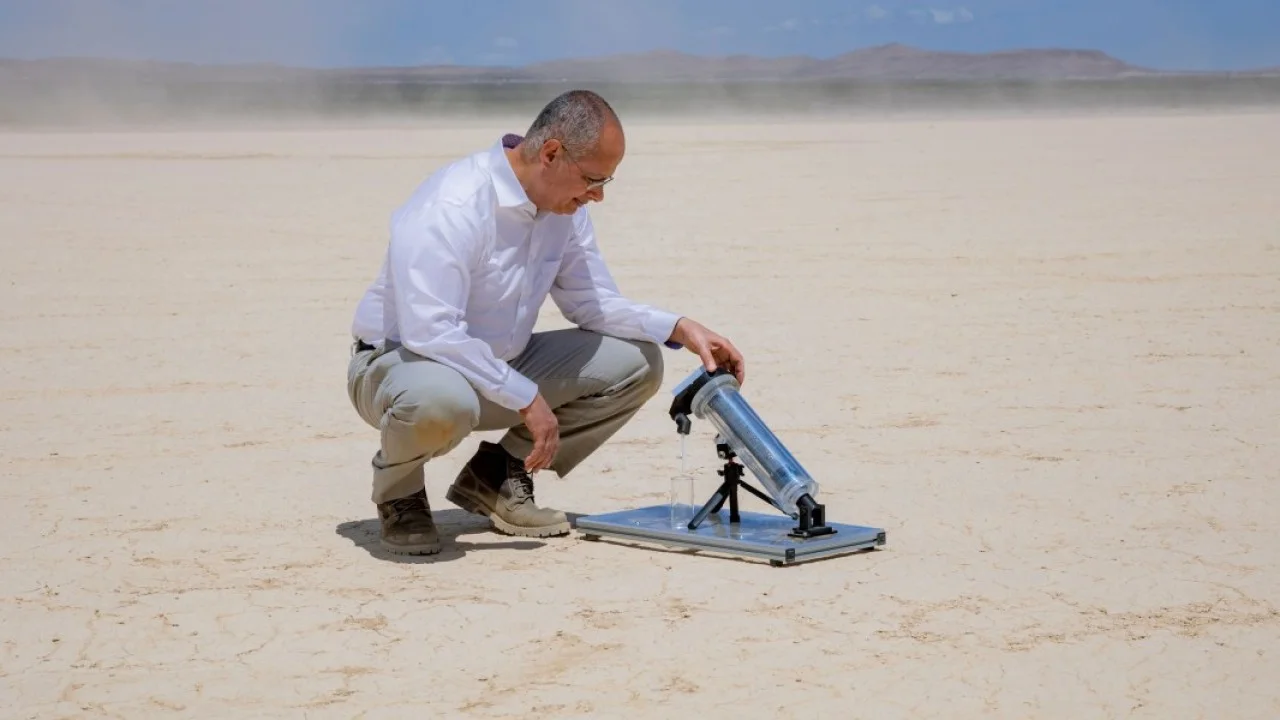
MOFs, Yaghi posits, offer a pathway to significantly reduce or even eliminate this energy dependency. Atoco’s prototype systems aim to harness the material’s natural affinity for water. The industrial-scale designs may use electricity to accelerate the process, but the company is actively developing a completely off-grid version that relies solely on ambient solar energy and temperature fluctuations.
The market for atmospheric water harvesting is already substantial, valued in the billions of dollars and projected to grow significantly over the next five years. This expansion is driven by a confluence of crises impacting traditional freshwater sources. Reduced snowfall in mountain regions limits meltwater, droughts are intensifying, and rising sea levels are contaminating underground aquifers. Add to this the persistent threats of aging infrastructure, chemical contamination, and microplastics, and the urgency for alternative water sources becomes clear.
Even in developed nations, water quality and reliable access are becoming concerns. Watergen, an Israeli firm, initially targeted arid regions but now finds significant demand in Europe and the United States from buyers seeking secure, clean water supplies. Anna Chernyavsky, Watergen’s VP of marketing, notes that the “water crisis” isn’t solely about availability but also about “access to good-quality water.”
Yaghi’s approach faces competition. AirJoule, another company developing MOF-based generators, has already deployed units in Texas and the UAE and is collaborating with researchers at Arizona State University. AirJoule utilizes off-the-shelf MOFs purchased from chemical giant BASF. In contrast, Atoco plans to leverage Yaghi’s expertise in designing novel MOFs tailored for specific environmental conditions and applications. Magnus Bach, Atoco’s VP of business development, highlights this advantage: “Given the fact that we have the inventor of the whole class of materials… we have a good starting point to engineer maybe the best materials in the world.”
Yaghi envisions a dual product strategy. Industrial units, capable of producing thousands of liters daily, would run on electricity. Simultaneously, passive systems, requiring no external power, could serve remote locations. He believes these technologies could eventually supplant desalination plants and even municipal water systems, offering what he calls “water independence.”
The next critical phase for Atoco involves field tests scheduled for early 2026 in the Mojave Desert, a location chosen for its extreme heat and aridity. The goal is to prove the MOF technology’s efficacy under the harshest conditions.
Decentralized water generation, akin to rooftop solar panels, is also on the horizon. Yaghi and Chernyavsky both see potential for home appliances that allow households to generate their own water off-grid. However, scaling down these complex processes—production, cooling, and filtration—into compact, affordable units presents significant engineering challenges. Yet, Yaghi’s childhood experiences fuel his drive to free people from reliance on external water sources, a fundamental necessity for their lives and livelihoods.