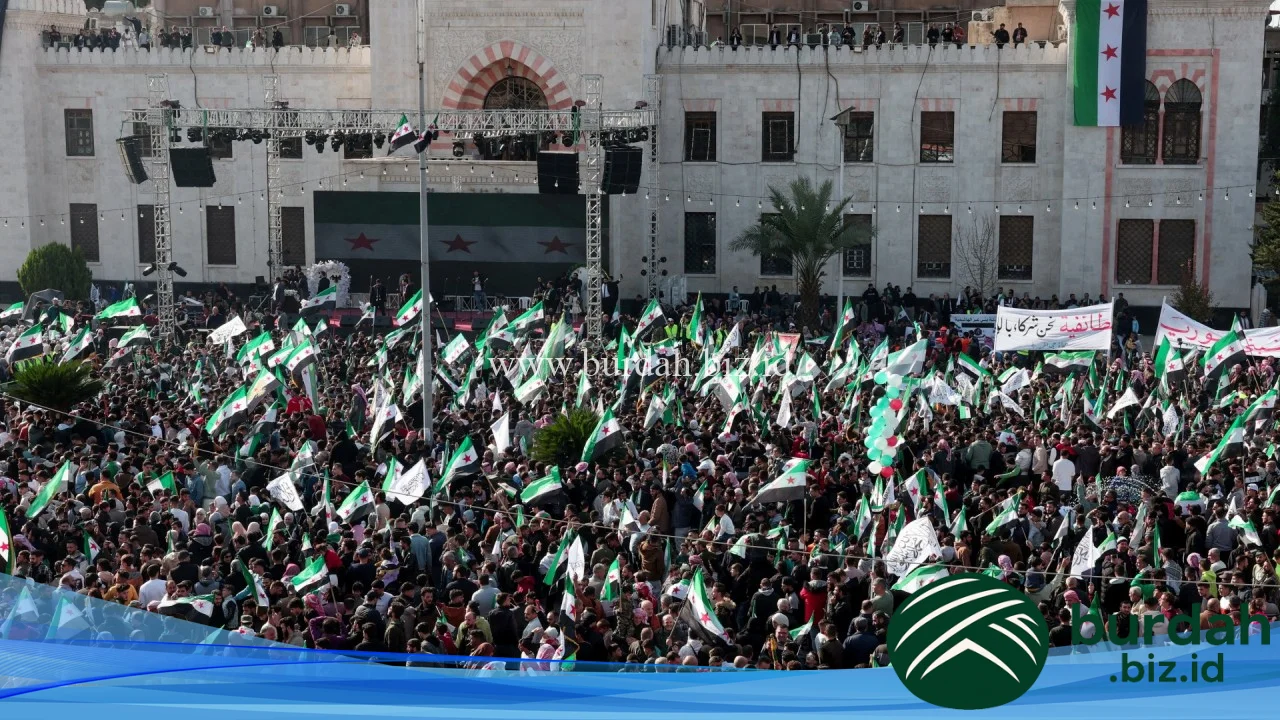
Thousands of people have flooded the streets of Hama, celebrating the first anniversary of the expulsion of forces loyal to Bashar al-Assad. The central Syrian city, a historic center of opposition, marked the day just over a year after the former ruler’s ouster.
The mood is electric. From Hama’s al-Assi Square, the atmosphere is one of profound “hope and belief” in the nation’s future. Al Jazeera’s Assed Baig reported scenes of pure jubilation.
“As far as I can see on balconies on roofs, people are out celebrating this day. They’re waving flags, they’re chanting slogans, they’re singing, and there’s hope for the future.”
This celebration marks a pivotal moment. The city’s liberation on December 5, 2024, was a key victory for rebel forces led by Ahmed al-Sharaa, now Syria’s transitional president. Days after taking Hama, their lightning offensive reached the capital, and they captured Damascus. Al-Assad’s 24-year rule collapsed, and his family’s long dynasty ended as he fled to Russia.
A City Haunted by its Past
The fall of the al-Assad regime carries a unique weight in Hama. The city is forever scarred by the memory of 1982, when a brutal crackdown was ordered by Bashar’s father, former President Hafez al-Assad. To crush an uprising, government forces besieged and bombed the city relentlessly.
Soldiers rounded up and executed young men and boys. Entire families disappeared. The Syrian Network for Human Rights estimates that between 30,000 and 40,000 people were killed in the massacre.
Baig noted the stark contrast between then and now. His last visit two decades ago was under a cloud of paranoia.
“Back then, people would whisper, there was a sense of fear that the wrong word, the wrong sentence, could cause you to end up in trouble, disappeared to the regime forces’ prison or maybe even worse. Now people are happy, celebrating, joyous.”
A New Chapter Under a Controversial Leader
Syria’s new leader, Ahmed al-Sharaa, has had a remarkable and controversial journey. Once the head of al-Qaeda’s Syrian branch and later the splinter group Hayat Tahrir al-Sham, he has orchestrated an incredible political pivot since taking power. His administration has worked to restore Syria’s international standing, successfully securing critical sanctions relief.
Serving a five-year transitional term, President al-Sharaa has engaged in a whirlwind of diplomacy, touring capitals from the Gulf to Europe and even Washington. Just this week, he hosted a United Nations Security Council delegation in Syria. In a historic moment in September, al-Sharaa became the first Syrian leader in six decades to address the United Nations General Assembly.
Persistent Dangers and Sectarian Fears
The newfound hope is fragile. Deep concerns remain over ongoing sectarian bloodshed, particularly in the heartlands of Syria’s Alawite and Druze minorities. Some government forces and their allies have been implicated in these reprisal attacks and have faced trial.
The violence is significant. According to the Syrian Observatory for Human Rights, clashes and reprisals targeting the Alawite community—from which the al-Assad family hails—killed over 1,700 people in March. More bloodshed followed in July, when clashes in the southern Druze-majority province of Suwayda left hundreds more dead, including many civilians.
The situation has drawn in regional powers. Israel has intervened with air strikes in southern Syria and Damascus, claiming its operations were to protect the Druze community. Many Druze leaders have rejected this claim. Israeli incursions continue; last week, an Israeli strike in the Damascus countryside, in Beit Jinn, killed at least 13 people, including children.
Experts acknowledge the progress but caution against unchecked optimism. Nanar Hawach, a senior Syria analyst at the International Crisis Group, noted the difficult road ahead.
“Syria has opened a new chapter that many once thought impossible by rebuilding diplomatic ties and drawing foreign investment. But international rehabilitation means little if all Syrians don’t feel safe walking their own streets.”
For many Syrians, the fear of a total collapse of the state is a powerful motivator. Gamal Mansour, a researcher at the University of Toronto, says that many see al-Sharaa as the only viable path forward, believing he is “the only option that provides guarantees” against a chaotic power vacuum. Back in Hama, amidst the celebrations, that sentiment holds true. There is a palpable hope, as Baig says, that “the government will be able to deliver … unity and freedom for all Syrians.”